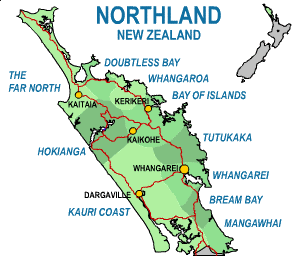
The harbour was the scene of one of the most notorious incidents in early New Zealand history, the Boyd massacre. In December 1809 almost all the crew and 70 passengers were killed as utu (revenge) for the mistreatment of Te Ara, the son of a Ngāti Uru chief, who had been in the crew of the ship. Several days later the ship was burnt out after gunpowder was accidentally ignited. Relics of the Boyd are now in a local museum.
On 16 July 1824 on a voyage to Sydney from Tahiti, the crew and passengers of the colonial schooner Endeavour (Capt John Dibbs) stopped in Whangaroa Harbour. An altercation with the local Māori Ngāti Pou hapū (subtribe) of the Ngā Puhi iwi resulted in an incident where Maori warriors took control of the Endeavour and menaced the crew. The situation was defused by the timely arrival of the Ngāti Uru chief Te Ara, of Boyd fame.[2]
In February 1827, the famous Ngā Puhi chief Hongi Hika was engaged in warfare against the tribes of Whangaroa.[3] Acting contrary to the orders of Hongi Hika, some of his warriors plundered and burnt Wesleydale, the Wesleyan mission that had been established in June 1823 at Kaeo,[4] nine kilometres from Whangaroa. The missionaries, Rev Turner and his wife and three children, together with Rev. Messrs, Hobbs and Stack, and Mr Wade and wife, were ‘compelled to flee from Whangarooa (sic) for their lives’. They were conveyed by ship to Sydney, NSW.[5] During a skirmish Hongi Hika was shot in the chest by one of his warriors.[4] On 6 March 1828 Hongi Hika died at Whangaroa.[6] There is no actual evidence that Hongi himself plundered the mission; he was busily pursuing the enemy and being wounded. Nor is there any direct evidence to implicate anybody else [7] An alternate ideas was put forward by William Williams of the CMS. ” It appears beyond doubt, though our Wesleyan Friends are loathe to believe it, that it was their own chief, Tepui, was the instigator of the whole business”. [8] The local Ngatiuru had made the land available to the mission. For years the missionaries had lived amongst them and grown prosperous while the tribe still ate fern root.There was no prospect of the missionaries moving on and no prospect of them becoming acceptable neighhbours.They had not joined the tribe. They had set up their own tribe which was steadily wearing down the authority of the Ngatiuru leadership. [9]
Why was the Boyd attacked?
Often referred to as the ‘Boyd Massacre’ or the ‘Burning of the Boyd’, the incident was dismissed as an act of Māori barbarism. From this perspective, there was little need to examine Māori motives. The event was etched into New Zealand folklore by European artists several generations after the actual attack. Their romanticised and often inaccurate portrayals embedded the incident in a frontier context resembling North America’s Wild West.
Under the command of Captain John Thompson, the Boyd left Port Jackson (Sydney) in October 1809 and arrived in Whangaroa Harbour in the far north to load a cargo of kauri spars. It was probably only the third European ship to visit Whangaroa. A year earlier, the crew of the Commerce had caused an outbreak of disease that killed a number of Māori. Ngāti Uru believed that a curse had been placed on them and viewed the next European visitors, those on the Boyd, with apprehension and suspicion. For his part, this was to be Captain Thompson’s first – and last – encounter with Māori.
Utu is taken
Among the 70 people on board the Boyd was Te Ara, the son of a Whangaroa chief. Te Ara had been expected to work his passage as a seaman, but he ignored orders. He may have been ill, or, as the son of a chief, he may have believed that such work was beneath him. Whatever his reasons, he was flogged and denied food. When he arrived home and reported this mistreatment, his kin demanded utu.
Unaware of local feelings, Thompson and several crew members left the ship with a group of Māori to check out a stand of kauri further up the harbour. Once ashore they were killed and eaten. At dusk some Māori disguised themselves as the returning shore party while other warriors waited in canoes for the signal to attack. The assault was swift and decisive. Most of the Europeans were killed that evening, although a number escaped by climbing up into the ship’s rigging.
Te Pahi arrives
The next morning a large canoe entered the harbour carrying Te Pahi, a prominent chief from Rangihoua in the Bay of Islands who supported trade with Europeans and had visited Sydney in 1805. Shocked by what he found, he tried to rescue the frightened Europeans still clinging to the ship’s rigging. However, Te Ara’s relatives thought the matter none of Te Pahi’s business and killed most of the survivors. In a classic case of mistaken identity, Europeans would later blame Te Pahi for the tragedy.
The Boyd was then towed up the harbour towards Te Ara’s village and grounded on mudflats near Motu Wai (Red Island). The ship was pillaged of its cargo, with muskets and gunpowder being especially prized booty.
During the pillaging a musket flint ignited the gunpowder on board, causing a massive explosion that killed a number of Māori, including Te Ara’s father. Fire soon spread to casks of inflammable whale oil, and the Boyd burned down to the waterline.
Survivors
Several Europeans survived both the initial attack and its immediate aftermath. They included Thom Davis (the ship’s cabin boy), Ann Morley and her baby, and two-year-old Betsey Broughton, who was taken by a local chief. Thom was spared because he had tended to Te Ara after his flogging and had smuggled food to him. The second mate was put to work making fish-hooks from barrel hoops, but when he proved incompetent at this task he was killed and eaten.
European utu
Rumours of the incident reached the Bay of Islands, and three weeks later the City of Edinburgh and other vessels to investigate. A Māori chief from the Bay of Islands who accompanied the European force negotiated the return of Ann Morley, her baby and Thom Davis. The taking of hostages secured the release of Betsey Broughton after a short delay.
Asked why they had attacked the ship, some of those involved said that the captain was a ‘bad man’. The whalers present blamed Te Pahi for the incident, even though the real perpetrators declared his innocence. Te Pahi’s pā, Te Puna, was destroyed by the European sailors, with considerable loss of Māori life.
This action resulted in civil war breaking out in the region, and in a final cruel irony, Te Pahi died of wounds received in battle in 1810. When Samuel Marsden arrived in 1814 to establish his Church Missionary Society mission, tensions still simmered. He invited chiefs from Whangaroa and the Bay of Islands aboard his ship, the Active, gave them gifts and asked them to ensure peace between their people.
‘Each chief saluted the other,’ Marsden wrote, ‘and then went around to each one pressing their noses together.’ They also assured him that they would never harm another European.
Travel advisory
For some Europeans the Boyd incident put New Zealand in the ‘avoid if at all possible’ category. A pamphlet circulating in Europe warned sailors off the ‘Cannibal Isles’ – ‘touch not that cursed shore lest you these Cannibals pursue’.
References
- ^ “Whangaroa Travel Guide”. Jasons Travel Media.
- ^ Maxwell, Alexander; Roberts, Evan (2014). “The Whangaroa incident, 16 July 1824: A European–Māori encounter and its many incarnations”. The Journal of Pacific History. 49 (1): 50–75. doi:10.1080/00223344.2013.869845.
- ^ Caroline Fitzgerald (2011). Te Wiremu – Henry Williams: Early Years in the North. Huia Press. ISBN 978-1-86969-439-5.
- ^ Jump up to:a b Journal of William Williams, March 1st 1827 (Caroline Fitzgerald, 2011)
- ^ The Times, London, article CS118772953 dated 25 June 1827; retrieved 4 May 2004.
- ^ Journal of James Stack, Wesleyan missionary, March 12th 1828 (Caroline Fitzgerald, 2011)
- ^ J.M R.Owens (1974). Prophets In The Wilderness – The Wesleyan Mission to New Zealand 1819-27, p. 108. Auckland University Press
- ^ J.M R.Owens (1974). Prophets In The Wilderness – The Wesleyan Mission to New Zealand 1819-27, p. 109. Auckland University Press.
- ^ J.M R.Owens (1974). Prophets In The Wilderness – The Wesleyan Mission to New Zealand 1819-27, p. 112. Auckland University Press.
Wises New Zealand Guide, 7th Edition, 1979. p. 508.
Acknowledgements : Parts of this blogpost have been lifted from Wikipedia
 Madhuban - New Zealand